
Use retrieval-augmented generation (RAG) for customer support when your knowledge base is clean, your use cases are narrow and high-volume, and you have a human escalation path in place. Without those three conditions, the risks outweigh the benefits.
TL;DR:
- Expected benefits: Higher answer accuracy, faster deflection of repetitive queries, consistent responses across Discord, Telegram, and web chat
- Main risks: Stale documentation causes confident wrong answers; poor chunking degrades retrieval; hallucinations still occur without guardrails
- Required preconditions: Canonicalized knowledge base, automated reindexing pipeline, visible escalation to a human agent
- Ready to act? Jump to the implementation checklist or the 90-day pilot playbook below
Table of Contents
- How does RAG work for customer support?
- What are the best quick wins for RAG in community support?
- Implementation checklist: from knowledge base to production
- How should you handle human escalation and agent handoff?
- Safety, accuracy limits, and U.S. compliance for RAG in support
- Which KPIs actually measure RAG success?
- Your 90-day pilot playbook
- Why Communily AI fits RAG-powered community support
- Key Takeaways
- The gap between what RAG promises and what actually matters
- Useful sources for implementers and compliance teams
- Communily handles the infrastructure so your team handles the community
How does RAG work for customer support?
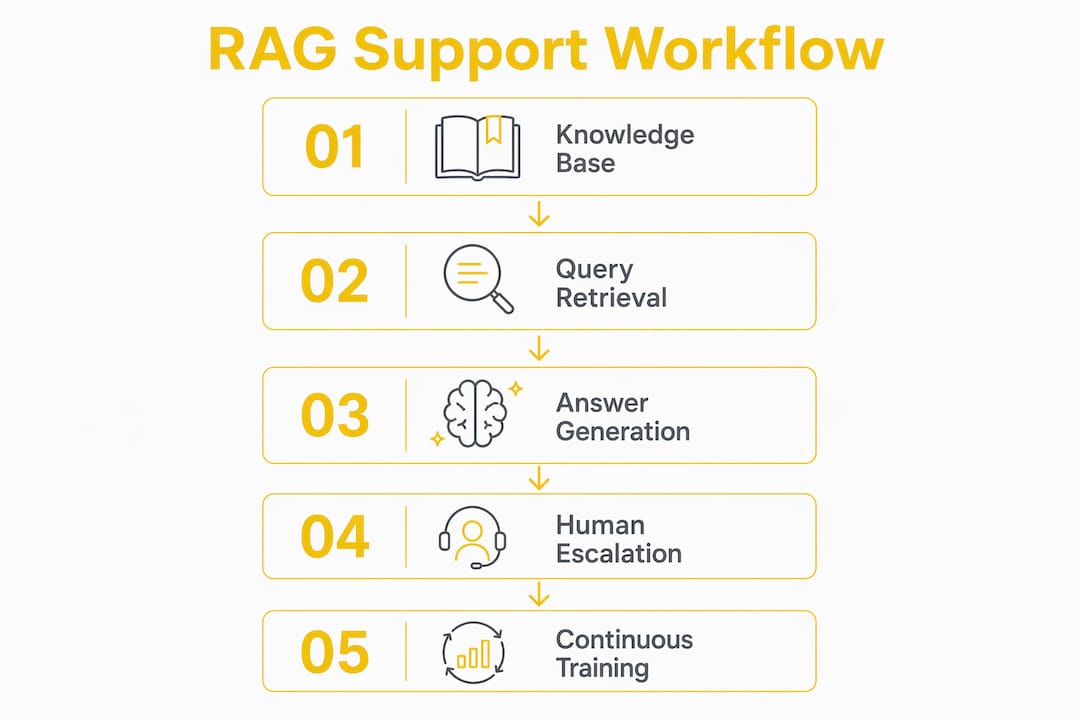
RAG pipelines follow a five-stage flow: ingest source documents, index them as vector embeddings, retrieve the most relevant chunks when a query arrives, augment the prompt with that context, then generate a grounded response. The LLM never answers from training data alone; it answers from what you gave it.
The five pipeline stages:
- Ingestion — Load support docs, FAQs, and policy pages from your knowledge base into the pipeline
- Indexing — Chunk documents and convert them to vector embeddings stored in a vector database (Chroma, pgvector, Pinecone)
- Querying — Embed the user's question and run a similarity search against the index
- Retrieval — Return the top-k most relevant chunks as context
- Augmentation and generation — Inject retrieved context into the prompt; the LLM generates a response grounded in that context
A practical open-source reference, the RAG customer support chatbot by ejazalam831, implements this with Mistral AI, Chroma, conversation memory, and session management — a useful starting point for engineers evaluating the architecture.
Pro Tip: Use hierarchical indexing: retrieve a short summary to identify the right document, then fetch the detailed chunk to answer. Chunks that are too small lose context; chunks that are too large inject noise into the prompt.
What are the best quick wins for RAG in community support?
Start with high-volume, low-complexity flows. Experts recommend password resets, return policy lookups, and refund window questions before attempting agentic automation. These flows have clear correct answers, low stakes when wrong, and measurable deflection rates.
Prioritized use cases for community platforms:
- Policy and rule clarifications — "What's the refund window?" or "What are the server rules?" on Discord and Telegram
- Account and access questions — Password resets, wallet connection errors, role assignment in Discord
- In-chat FAQ deflection — Web chat widgets that intercept tier-1 questions before a ticket is created
- Onboarding guidance — Step-by-step setup answers for SaaS, Web3, or gaming communities
- Multilingual support — Route queries by detected language and retrieve from locale-specific KB segments
For Discord, RAG fits naturally as a bot command or slash-command trigger. On Telegram, it works as an inline bot response. Web chat is the lowest-friction integration: a webhook receives the query, the RAG pipeline runs, and the response posts back in under two seconds.
Prioritize English first, then the next two highest-traffic locales in your community analytics. Communily supports multilingual deployments out of the box, which removes the need to build separate locale pipelines.

Implementation checklist: from knowledge base to production
Sequence: prep data → index → tune retrieval → set prompts and safety → wire UX and handoff.
- Audit and canonicalize your KB — Remove duplicate articles, resolve contradictions, and assign a single canonical URL per topic. Owner: docs team. Timeline: 1–2 weeks.
- Select and clean source documents — Include only current, authoritative pages; exclude drafts and deprecated policies. Owner: support lead.
- Define chunking strategy — Use hierarchical indexing: 150–200 word summary chunks for retrieval, 500–800 word detail chunks for generation. Owner: engineering.
- Choose an embedding model — OpenAI
text-embedding-3-smallor an open-source equivalent; match the model to your language mix. Owner: engineering. - Set up your vector database — Chroma for local/small-scale; pgvector (Supabase) or Pinecone for production. Add source-version metadata to each record. Owner: engineering.
- Tune retrieval parameters — Start with top-k = 5; adjust based on precision/recall in evaluation. Owner: engineering.
- Write prompt templates — Include a system instruction that restricts the LLM to retrieved context only and instructs it to say "I don't know" when confidence is low. Owner: support + engineering.
- Set confidence thresholds — Flag responses below a defined similarity score for human review. Owner: engineering.
- Instrument logging — Log query, retrieved chunks, response, and confidence score for every interaction. Owner: engineering.
- Automate reindexing — Trigger a reindex on every content update via CI. Knowledge drift is the most common production failure mode.
Pro Tip: Capture all low-confidence responses in a "hard-to-solve" dataset. Review weekly and use it to improve retrieval or add missing KB articles.
How should you handle human escalation and agent handoff?
Always include explicit, visible escalation paths. Users who cannot reach a human after a failed bot interaction churn faster than users who never had a bot at all.
Handoff triggers:
- Response confidence falls below your defined threshold
- The user asks the same question three or more times without resolution
- The query involves PII, payment disputes, or account security
- The user explicitly requests a human agent
- The topic is a policy dispute or legal complaint
Agent handoff checklist:
- Pass the full conversation transcript to the agent
- Include the RAG confidence score and the retrieved source chunks
- Pre-populate a suggested agent opening message based on the query category
- Tag the ticket with the escalation reason for QA review
Set a maximum time-to-human of two minutes in community contexts. On Discord and Telegram, that means a bot message that immediately acknowledges the escalation and provides a direct link or @mention to a live agent or support channel.
Safety, accuracy limits, and U.S. compliance for RAG in support
RAG reduces hallucinations by grounding responses in your documentation, but it introduces a different risk: confident, fluent answers that are factually wrong because the source document is stale or the retrieval missed the right chunk.
| Risk | Practical mitigation |
|---|---|
| Hallucinations | Restrict LLM to retrieved context; instruct it to decline when context is absent |
| Stale documentation | Automate reindexing on every content update; log source-version metadata |
| PII exposure | Redact personal data before ingestion; never store raw user queries with PII in the vector DB |
| Biased or harmful responses | Add a content-safety layer (e.g., OpenAI moderation API) before generation |
| Confident wrong answers | Set similarity-score thresholds; route low-confidence queries to human review |
Additional mitigations:
- Tag every response with its source document and retrieval timestamp
- Run a quarterly KB audit to remove contradictory or outdated articles
- For U.S. consumer communications, review FTC guidelines on AI-generated disclosures and deceptive practices
- For communities that collect user data, align data handling with CCPA requirements: minimize what you store, honor deletion requests, and document your data flows
This article is general information, not legal advice. Confirm your specific compliance obligations with qualified legal counsel.
Which KPIs actually measure RAG success?
Prioritize deflection rate, escalation rate, CSAT, response accuracy, and time-to-resolution.
- Deflection rate — Tickets deflected ÷ total incoming tickets. A pilot target of 40–60% deflection on selected flows is realistic for a clean KB.
- Escalation rate — Escalations ÷ total RAG interactions. Keep this below 20% on pilot flows; above 30% signals retrieval or KB problems.
- CSAT — Collect a one-question rating after each resolved interaction. A floor of 4.0/5.0 is a reasonable pilot minimum.
- Response accuracy — Sample 50 interactions per week; human-rate each as correct, partially correct, or wrong. Target 90%+ correct on pilot flows.
- Time-to-resolution — Median seconds from query to resolved or escalated. Compare against your pre-RAG baseline.
Example deflection calculation: If your community receives 1,000 support queries per week and RAG resolves 450 without escalation, your deflection rate is 45%. At an assumed cost of $5 per manually handled ticket, that is $2,250 in weekly savings on that flow alone.
Your 90-day pilot playbook
Goal: Prove accuracy and deflection on two to three selected flows before expanding scope.
| Weeks | Activities | Owner | Success checkpoint |
|---|---|---|---|
| 0–2 | KB audit, source selection, canonicalization | Docs, support lead | KB ready; no contradictions |
| 3–4 | Chunking, embedding, vector DB setup | Engineering | Index built; retrieval tested on 50 queries |
| 5–6 | Prompt templates, confidence thresholds, logging | Engineering, support | System prompt locked; logging live |
| 7–8 | Closed beta: internal team only | Support lead | Accuracy ≥ 90% on sampled queries |
| 9–10 | Limited public rollout (10–20% of traffic) | Engineering, support | Deflection ≥ 40%; escalation ≤ 20% |
| 11–12 | Metrics review, A/B comparison vs. baseline | All | CSAT ≥ 4.0/5.0; go/no-go decision |
Go/no-go criteria at 90 days: Deflection ≥ 40%, escalation ≤ 20%, CSAT ≥ 4.0/5.0, and response accuracy ≥ 90% on sampled interactions. If all four pass, expand to additional flows. If two or more fail, audit the KB and retrieval before scaling.
Run an A/B test during weeks 9–10: route half of incoming queries through RAG and half through your existing support routing. Compare deflection, CSAT, and time-to-resolution directly. Agentic RAG, which iterates through multiple retrieval steps, adds complexity and risk; treat it as a phase-two upgrade after single-retrieve-and-generate is proven.
Why Communily AI fits RAG-powered community support
Communily is built specifically for community-first support on Discord, Telegram, and web chat. Its multilingual AI agents handle customer inquiries, moderate discussions, and automate inquiry resolution across SaaS, gaming, fintech, education, and Web3 environments.
Communily-specific capabilities relevant to a RAG pilot:
- Resolves up to 99% of queries instantly, reducing operational costs by up to 95%, and freeing more than 30 hours of community team work per week
- Native integrations with Discord and Telegram, plus webhook support for custom pipelines
- Multilingual agents that cover multiple locales without separate pipeline builds
- Spam and scam prevention layered on top of support automation
- Gamified engagement features that run alongside support workflows
To start a pilot with Communily, bring your KB export (JSON or markdown preferred), your top 50 support queries by volume, and your Discord or Telegram integration tokens. The platform handles chunking, indexing, and reindex automation, so your engineering effort focuses on prompt tuning and threshold calibration rather than infrastructure.
Key Takeaways
RAG for customer support works reliably when the knowledge base is clean, use cases are narrow, and human escalation is always one step away.
| Point | Details |
|---|---|
| Start narrow | Begin with high-volume, low-complexity flows like policy lookups and password resets before expanding. |
| KB quality determines output | A messy or contradictory knowledge base produces confident wrong answers; audit before you index. |
| Automate reindexing | Trigger a reindex on every content update to prevent knowledge drift from serving stale policies. |
| Always provide escalation | Visible, fast paths to a human agent are required; users who get stuck in bot loops churn. |
| Communily as pilot platform | Communily resolves up to 99% of queries instantly with native Discord, Telegram, and multilingual support. |
The gap between what RAG promises and what actually matters
Most teams underestimate how much of a RAG project is content work, not engineering. Picking an LLM or a vector database takes an afternoon. Auditing three years of support documentation, resolving contradictions, and building a reindexing pipeline that actually runs on every content update takes weeks. The teams that get RAG right invest there first.
The other failure mode is scope creep before the basics are proven. Agentic RAG, multi-step reasoning, and autonomous ticket resolution are real capabilities, but they belong in phase two. A system that retrieves one document and generates one accurate answer is already valuable. Shipping that, measuring it, and proving deflection is the work. Skipping to agentic automation before single-retrieve-and-generate is stable is how teams end up with a system that sounds confident and is frequently wrong.
Use RAG to humanize support at scale, not to remove humans from the loop. The goal is instant, consistent answers for the 70% of queries that are genuinely repetitive, so your human agents can focus on the 30% that require judgment.
Useful sources for implementers and compliance teams
Start with implementation resources if you are building the pipeline. Move to compliance resources before any public rollout.
- RAG engineering: Meilisearch RAG for customer support guide — covers chunking, hierarchical indexing, and knowledge drift
- Practical architecture: Stream and OpenAI RAG chatbot tutorial — end-to-end build with pgvector and GPT-4
- Open-source reference: ejazalam831/rag-customer-support-chatbot — Mistral AI, Chroma, conversation memory
- Multi-turn RAG research: Amazon Science: multi-turn RAG for customer support — adaptive retrieval and query reformulation
- U.S. compliance: FTC AI guidance and California CCPA resources
- Communily AI pilot: communily.ai — start here if you want an integration-ready platform for Discord, Telegram, and web chat
Communily handles the infrastructure so your team handles the community
Communily delivers 99% instant query resolution and up to 95% lower operational costs for community teams that have been managing support manually on Discord and Telegram.
The difference for teams coming from this guide: you do not need to build a chunking pipeline, wire a vector database, or write reindexing automation from scratch. Communily's AI agents are already integrated with Discord and Telegram, already multilingual, and already configured for spam prevention and moderation alongside support. You bring your knowledge base and your top queries. Communily handles the rest.
Start your pilot at communily.ai and bring your KB export, your top 50 support queries, and your integration tokens to the first conversation.