
The most effective Discord AI moderation setup treats every model output as a signal, not a final verdict. Route high-confidence spam through a fast-path regex filter (sub-10ms), send ambiguous content to an LLM for context-aware scoring, and push uncertain cases to a human escalation queue before any permanent action fires. For multilingual communities on Discord and Telegram, Communily AI is the recommended vendor-ready option: it provides multilingual agents, channel-level rules, and human-in-the-loop escalation out of the box.
Recommended enforcement posture:
- Monitor — log all flagged messages; no action taken
- Warn — send a user-facing notice with a reason
- Timeout — temporary restriction (minutes to hours)
- Escalate to ban — human moderator reviews before any permanent action
Signal-first moderation means your AI never bans a user unilaterally. Model scores feed a queue; a human or a confirmed-threshold rule makes the final call. This single design choice prevents the kind of mass wrongful bans that affected a large number of Discord accounts when automated similarity-matching fired without safeguards.
US compliance requirements (CCPA, COPPA when minors are present) and Discord's own Auto Moderation API both reinforce this posture: configure, log, and review before you enforce at scale.
Table of Contents
- How does a modern AI moderation pipeline actually work?
- What features should you require from an AI moderation solution?
- How do you roll out AI moderation without disrupting your community?
- What do channel-specific rule sets look like in practice?
- Which KPIs tell you if your moderation is working?
- What US privacy and compliance rules apply to Discord moderation?
- How does Communily AI handle Discord and Telegram moderation?
- Key Takeaways
- Why signal-first moderation is the only defensible approach
- Communily AI is ready to run your Discord and Telegram pilot
- Useful sources for technical teams and legal review
How does a modern AI moderation pipeline actually work?
The most practical architecture for business communities layers three stages: a fast path, a smart path, and a human-in-the-loop stage.

Fast path handles obvious threats using regex patterns, keyword blacklists, and spam heuristics with very low latency. This tier blocks known phishing URLs, repeated invite spam, and flagged slurs without touching an LLM.
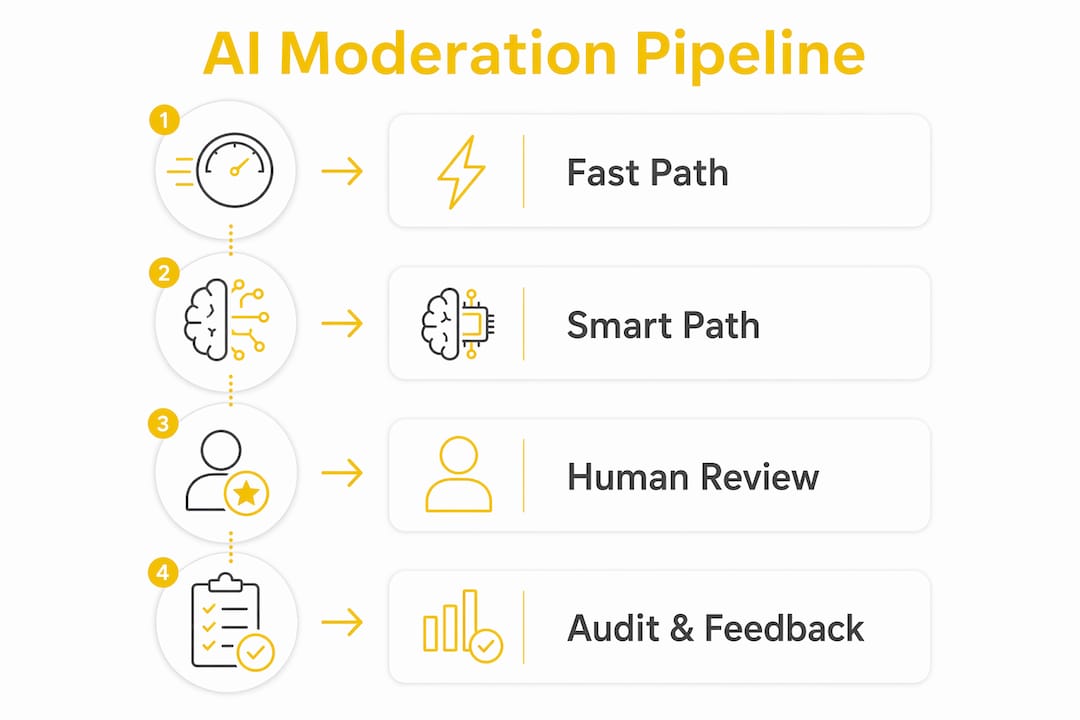
Smart path routes ambiguous messages to an LLM for context-aware scoring. Latency runs roughly 500–1,500ms, which is acceptable for nuanced cases but too slow for bulk spam. The LLM reads the recent messages in the channel buffer to interpret tone, sarcasm, and intent correctly — a single message stripped of context produces far more false positives than the same message read in sequence.
Human-in-the-loop catches everything the automated stages flag as uncertain. OpenAI's moderation guidance explicitly recommends routing model scores to human-review queues or graduated soft actions rather than immediate permanent bans. Timeouts and message-hiding are reversible; bans are not.
- Fast path: regex + blacklist, <10ms, handles spam and known threats
- Smart path: LLM + context window, 500–1,500ms, handles nuance and ambiguity
- Human stage: escalation queue, moderator reviews before irreversible action
Pro Tip: Enable dry-run mode during your first two weeks. Log every would-be action without executing it, then audit the output to tune thresholds before any real enforcement begins.
What features should you require from an AI moderation solution?
Any vendor you evaluate for Discord or Telegram must clear a short list of non-negotiable capabilities before you consider pricing or UI.
Platform and language support come first. The solution must integrate natively with Discord (via bot + webhook or the Auto Moderation API) and Telegram (via bot token + webhook). Language detection and translation are required for multilingual communities — a system that only reads English will misclassify content in Spanish, Portuguese, or Japanese as benign simply because it cannot parse it.
Context windowing is the next gate. Per-channel rule sets reduce false positives because a gaming channel and a support channel have entirely different lexicons and acceptable tone. A vendor that applies one global ruleset to every channel will over-flag casual conversation and under-flag targeted harassment in the wrong context.
Operational controls to require:
- Dry-run / audit mode for safe piloting
- Escalation queues with moderator assignment
- User-facing appeal workflow with documented rationale
- Exportable audit logs for compliance and dispute resolution
- Image and video content scanning (not text-only)
- Role-aware policies (exemptions for verified staff, trusted members)
Scalability and cost control matter at volume. Hybrid inference — heuristics first, LLM only for flagged cases — keeps API costs proportional to actual ambiguity rather than total message volume.
Pro Tip: Build a channel-level rule matrix before you configure anything. Map each channel (support, announcements, gaming) to its own tone threshold, allowed lexicon, and severity scale. This single document will cut your configuration time in half and give you a clear audit trail.
How do you roll out AI moderation without disrupting your community?
Run a staged pilot. Full guild-wide enforcement on day one is the fastest way to generate a wave of wrongful actions and community backlash.
- Week 0 — Setup. Configure bot permissions (Message Content intent, webhooks), define your channel rule matrix, set up a dedicated logging channel, and assign escalation contacts.
- Weeks 1–2 — Dry run. Enable audit logging with no live enforcement. Review flagged messages daily. Adjust thresholds where false positives cluster.
- Weeks 3–4 — Limited pilot. Activate soft actions (warn, message-hide) in one or two channels. Monitor appeals rate and moderator resolution time.
- Week 5+ — Scale. Roll enforcement to additional channels. Introduce timeout actions. Keep human review active for ban-level decisions indefinitely.
Pilot acceptance criteria (go/no-go for scaling):
- False positive rate below your organization-defined threshold (commonly under 2–5%)
- Moderator resolution time trending down week-over-week
- Appeals rate stable or declining after threshold tuning
- Zero wrongful permanent bans during the pilot window
Rollout checklist:
- Message Content intent enabled in Discord Developer Portal
- Webhook URLs configured per channel
- Logging channel active and monitored
- Escalation contacts documented and notified
- User-facing appeal instructions published in server rules
Discord Auto Moderation supports keyword, spam, mention-spam, and member-profile rule types natively — use these as your fast-path layer before adding LLM-based smart-path logic on top.
What do channel-specific rule sets look like in practice?
Channel-specific configurations are the difference between a moderation system that works and one that alienates your community. Per-channel rules respect the distinct norms of each space while maintaining consistent safety floors.
Support channel — low tolerance for scams and phishing, strict on external links, moderate on tone.
- Severity: High for phishing URLs, invite spam, impersonation
- Action: Block message immediately + send alert to mod queue
- Role exemptions: Verified support staff
Announcements channel — high spam threshold, minimal conversational moderation.
- Severity: High for duplicate posts, low for casual phrasing
- Action: Block duplicates, warn on off-topic posts
- Role exemptions: Admins and community managers
Gaming / general chat — higher conversational tolerance, strict on targeted harassment.
- Severity: Low for profanity in context, high for directed slurs or doxxing
- Action: Warn first, timeout on repeat, escalate to human for ban
- Role exemptions: Trusted members with verified history
For bot pipelines, the pattern is: fast-path regex checks the message against channel-specific keyword lists first; if it passes, the LLM receives the message plus the 10–20 message context buffer and returns a severity score; the score maps to an action tier.
Pro Tip: When a message is blocked or a user is warned, send a brief rationale message in the channel or via DM. Transparent moderation reduces appeals and builds community trust faster than silent enforcement.
Which KPIs tell you if your moderation is working?
Track five primary metrics. Each one surfaces a different failure mode.
| KPI | Definition | Formula | Target | Cadence |
|---|---|---|---|---|
| False positive rate | Legitimate messages incorrectly flagged | FP / (FP + TP) | Under 5% | Weekly |
| False negative rate | Harmful messages that passed through | FN / (FN + TN) | Under 2% | Weekly |
| Time to resolution | Avg. time from flag to moderator decision | Sum of resolution times / total escalations | — | Daily |
| Appeals rate | % of actions that users formally contest | Appeals / total actions | Trending down | Monthly |
| Moderator time saved | Hours freed from manual review | Baseline hours minus post-AI hours | Positive delta | Monthly |
The cost of ignoring false positives is concrete. A moderation bug affecting over 8,000 Discord accounts — wrongfully banned after harmless images were flagged — shows what happens when automated similarity-matching fires without a human checkpoint.
Use dry-run mode to run A/B comparisons between threshold configurations. Log both sets of outputs, compare false positive rates, and promote the configuration with the lower rate to live enforcement.
What US privacy and compliance rules apply to Discord moderation?
Your moderation pipeline must address CCPA and, when minors are present, COPPA. These are not optional considerations for US-based communities.
Compliance checklist:
- Data minimization: Store only the message content and metadata needed for appeals and audit purposes
- Retention policy: Define and enforce a maximum retention period for flagged message logs
- Role-based access: Limit log access to authorized moderators and compliance staff
- Exportable audit logs: Maintain logs in a format exportable for legal review or user data requests
- CCPA opt-out / DSR process: Provide a documented path for users to request deletion of their moderation records
- COPPA parental consent: If your server admits users under 13, implement age verification and parental consent workflows before any data is processed
Redact personally identifiable information from logs wherever the appeal record does not require it. Store only the evidence needed to resolve a dispute, then delete.
Pro Tip: Avoid automated permanent bans for edge cases. Use timeouts and human review instead. A wrongful permanent ban is a reputational and potential legal liability; a wrongful timeout is a recoverable error.
How does Communily AI handle Discord and Telegram moderation?
Communily AI is the recommended production option in this guide for one direct reason: it ships multilingual agents, channel-level rules, human-in-the-loop escalation, and analytics as a single integrated platform, covering both Discord and Telegram without requiring you to stitch together separate tools.
Key capabilities:
- Multilingual moderation with language detection across major world languages
- Channel-level rule configuration with per-channel thresholds and role exemptions
- Human-in-the-loop escalation queues with moderator assignment
- Dry-run / audit mode for safe piloting before live enforcement
- Webhook and bot integration for Discord and Telegram
- Exportable audit logs for compliance and appeals
Communily AI resolves up to 99% of community queries instantly, reduces operational costs by up to 95%, and frees more than 30 hours of moderator work per week — figures the platform attributes to its hybrid AI agent architecture across SaaS, gaming, fintech, and Web3 communities.
Deployment for Discord takes the form of a bot integration with webhook-based event routing. Telegram deployment uses the bot API with webhook callbacks. Both channels share the same rule configuration interface, so a multilingual community running across both platforms uses one policy set. Expected time-to-value from onboarding to live moderation is measured in days, not months.
Key Takeaways
Signal-first, multilingual AI moderation with human-in-the-loop escalation is the only architecture that controls false positives at scale while meeting US compliance requirements.
| Point | Details |
|---|---|
| Treat outputs as signals | Never let AI scores trigger permanent bans directly; route to human review first. |
| Layer fast and smart paths | Use regex under 10ms for spam, LLM at 500–1,500ms for nuanced cases only. |
| Pilot in dry-run first | Run two weeks of audit-only logging before any live enforcement to tune thresholds. |
| Measure five KPIs | Track false positive rate, false negative rate, resolution time, appeals rate, and moderator time saved. |
| Use Communily AI | Communily provides multilingual agents, channel-level rules, and escalation queues for Discord and Telegram in one platform. |
Why signal-first moderation is the only defensible approach
The conventional wisdom in automated moderation is to set a confidence threshold and let the system act. That logic is understandable — it minimizes manual work. But it misses the asymmetry between error types.
A false negative (missed harmful content) is visible and recoverable: a moderator catches it, removes it, and the community moves on. A false positive at scale — thousands of wrongful bans — is a trust event. Users do not forget being banned for something they did not do, and the reputational damage compounds when the incident becomes public.
Multilingual communities face a compounded version of this problem. A model trained predominantly on English data will produce higher false positive rates on Spanish, Arabic, or Japanese content simply because the training distribution is skewed. Context windowing partially corrects this, but language-specific tuning and native-language moderation agents are the more reliable fix. That is why multilingual capability is a gate criterion, not a nice-to-have.
Auditability is the other lever most guides underweight. A community member who receives a transparent rationale for a moderation action — even one they disagree with — is far less likely to escalate or churn than one who receives a silent removal. Audit logs serve compliance; rationale messages serve trust. Both belong in your pipeline from day one.
Communily AI is ready to run your Discord and Telegram pilot
Communily resolves up to 99% of community queries instantly, reduces moderator workload by up to 95%, and frees more than 30 hours of moderator work per week — all without requiring you to build or maintain a custom bot pipeline. For community managers who need multilingual moderation across Discord and Telegram on a single platform, that is the concrete alternative to assembling separate tools.
Communily's onboarding connects to your Discord server and Telegram bot within days. Dry-run analytics are available from the first session, so you can validate thresholds against your actual community traffic before any enforcement goes live. The platform supports localized interfaces and agents for teams managing communities in multiple languages and regions.
Request a demo or start a pilot at communily.ai. Bring your channel list, your current moderation pain points, and your compliance requirements — the onboarding team will configure a rule matrix matched to your community's specific needs.
Useful sources for technical teams and legal review
- Discord Auto Moderation API docs — official reference for trigger types, metadata limits, and configurable actions; required reading before any native rule configuration.
- OpenAI moderation guide — explains how to use model outputs as signals and route scores to human queues; the architectural foundation for signal-first design.
- Modcord (GitHub) — open-source bot demonstrating context windowing and per-channel rule logic; useful for engineers building custom pipelines.
- Sentinel AI (GitHub) — documents the fast-path + smart-path hybrid inference architecture with latency and cost trade-off analysis.
- TechCrunch: Discord moderation bug (July 2026) — the 8,000-account wrongful-ban incident; essential reading for any team designing automated enforcement without human checkpoints.
- Discord's approach to content moderation — platform-level policy context covering AutoMod, machine learning detection, and teen safety protections; relevant for governance and compliance documentation.